From wiring
to response.
What fruit-fly connectomes reveal. What computational models can test. Where a concept demonstration begins.
Abstract
A connectome records neural structure. A computational model adds assumptions about how activity travels through that structure. This briefing reads three research figures together: a female whole-brain reconstruction, a sensorimotor model and a male central nervous system map. They provide distinct evidence about anatomy and response, rather than a single claim that a digital organism reproduces every property of a living fly.
01 / STRUCTURAL EVIDENCE
First, make the wiring inspectable.
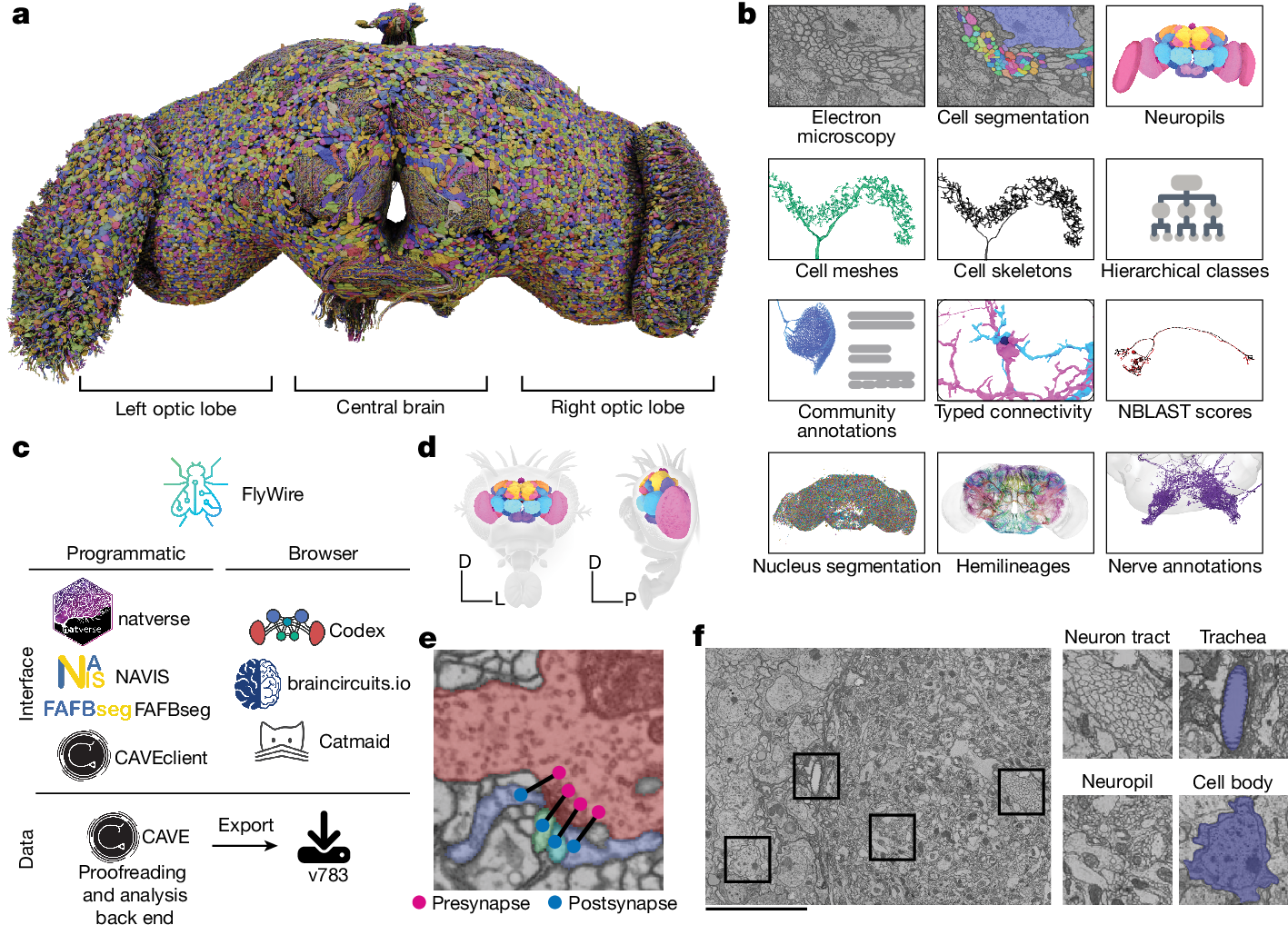
Dorkenwald and colleagues reconstructed 139,255 neurons and roughly 50 million chemical synapses in an adult female brain. The figure connects the overall anatomy with the imaging and annotation work that makes the network searchable. It is a structural map, not a recording of ongoing neural activity. [1]
02 / FUNCTIONAL PREDICTION
Then ask what a stimulus could do.
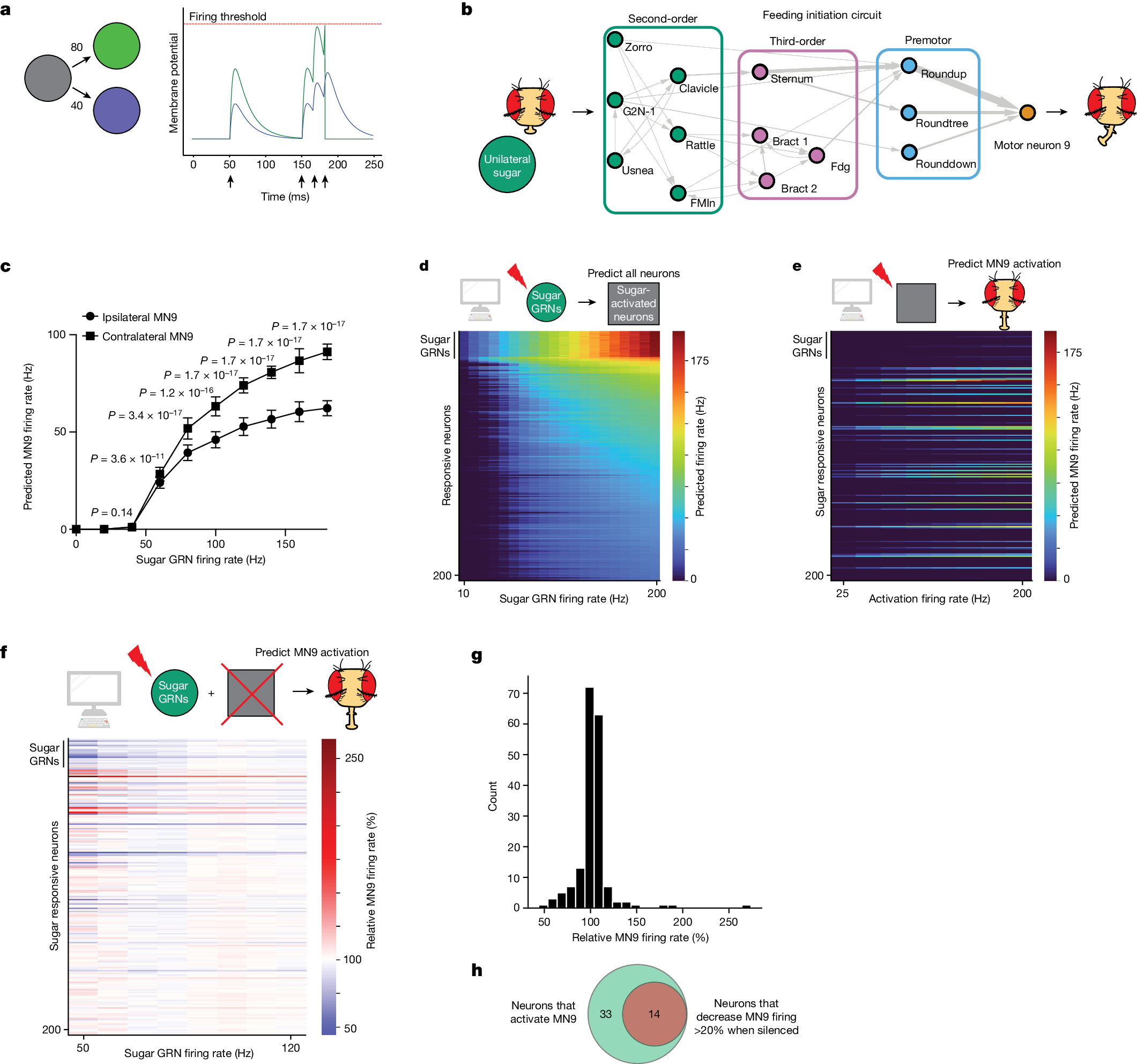
A connectome-constrained model translates synaptic wiring into predicted activity. Sugar-sensing inputs and feeding-related outputs provide a concrete sensorimotor test case. The circuit schematic defines the model; the response maps compare predicted activity under stimulation and silencing. Model output remains conditional on its neuron dynamics, connectivity and input assumptions; agreement with selected experiments is not evidence that every behavior has been reproduced. [2]
03 / A BROADER ANATOMICAL SCOPE
Look beyond the brain alone.
The male central nervous system reconstruction brings the brain and ventral nerve cord into one map, with neuron annotations and comparisons across existing connectomes. Panels a–b locate the tissue and reconstruction. Later panels organize cell classes and compare matching neurons across datasets. The reproduced figure is from the October 2025 preprint, not the final Cell layout published in September 2026. [3]
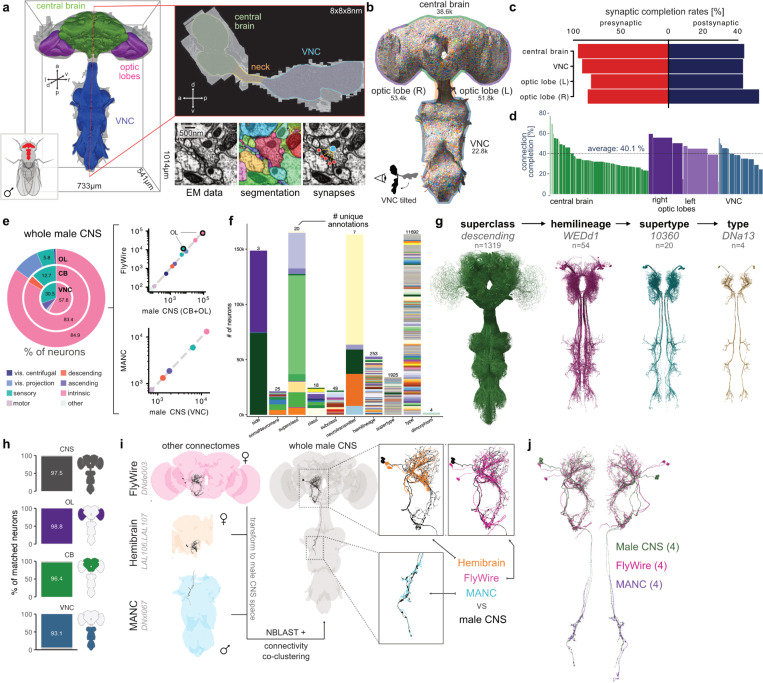
Version note: preprint v2, 30 October 2025.
RESEARCH UPDATE / SEPTEMBER 2026
AI reconstruction, shared as a scientific resource.
Google Research’s account of the male CNS project describes AI reconstruction, human proofreading and public data access. The published milestone spans more than 166,000 neurons and 125 million synaptic connections. Its value here is a concrete example of AI assisting the production of an inspectable anatomical resource. [4]
Open the Janelia dataset ↗04 / PROJECT INTERPRETATION
A visible sequence, with visible boundaries.
The Immortal Fruit interface borrows the sequence of sensing, attention and response to explain a Flap-token shortlist and fixed execution rules. Its fly visualization is conceptual; sample signals and activity are simulated. No live neural measurements, trained trading model, wallets or execution results are connected.
The two social demos supplied as visual references pair an environment with changing neural displays. That is a useful storytelling device, but the posts do not supply sufficient methods or data to treat their displayed dopamine values as verified scientific measurements. [5] [6]
These papers do not validate the site’s trading rules, establish digital consciousness or demonstrate immortality. Research measurements remain attributed to their original specimens and studies.
Sources & figure credits
- Dorkenwald et al. — Neuronal wiring diagram of an adult brain. Nature (2024). Fig. 1, CC BY 4.0.
- Shiu et al. — A Drosophila computational brain model reveals sensorimotor processing. Nature (2024). Fig. 1, CC BY 4.0.
- Berg et al. — Sexual dimorphism in the complete connectome of the Drosophila male central nervous system. bioRxiv v2, 30 Oct 2025. Fig. 1, CC BY 4.0. Final publication: Cell, 3 Sep 2026.
- Januszewski & Jain — A connectomics milestone: Mapping the complete male fruit fly brain. Google Research, 3 Sep 2026.
- joowon / @n0w00j — Fly rest-scene demonstration. X, Sep 2026. Visual reference only.
- @Yumzlef — Fly and reels demonstration. X, Sep 2026. Visual reference only.
Figure files are preserved without modification. The main atlas uses a disclosed monochrome display treatment; this report retains original colors. References checked 16 Sep 2026. No affiliation with the cited researchers or organizations is implied.